Sumatran tiger is a subspecies of tiger found on the Indonesian island of Sumatra. The Sumatran tiger is the smallest of the tiger subspecies as compared to the Siberian tiger which is the largest.
Analysis of DNA is consistent with the hypothesis that the Sumatran Tigers have been isolated from other tiger populations after a rise in sea level at the Pleistocene to Holocene border (about 12,000-6,000 years ago). In agreement with this evolutionary history, the Sumatran Tiger is genetically isolated from all living mainland tigers, which form a distinct group, closely related among each other.
Mt. Bromo at 2,329 metres (7,641 ft) is without doubt East Java's most well known attraction. The pre-dawn departure and trek across the mountain's 'sand sea' to watch the sun rise at the crater rim has become a daily ritual, joined by visitors from all over the world. Although by no means the highest mountain in the region, Bromo has gained a reputation on account of its fantastic surrounding landscape. Little wonder that this mountain has been revered for centuries by the local inhabitants, the Tenggerese, who claim descent from a princess of Majapahit.
Each year, on the fourteenth day of the Tenggerese month of Kasodo, which falls in December, a special ceremony is held on the sand sea below the crater of Bromo. Livestock and agricultural produce are offered to the spirit of the mountain as a kind of thanksgiving, and as a request for a bountiful harvest in the coming year. The Tenggerese believe that failure to observe this annual ceremony will result in a calamity.
Prambanan is a ninth century Hindu temple compound in Central Java, Indonesia, dedicated to the Trimurti, the expression of God as the Creator (Brahma), the Sustainer (Vishnu) and the Destroyer (Shiva). The temple compound is located approximately 18 km east of Yogyakarta city on the boundary between Yogyakarta and Central Java province.
The temple, a UNESCOWorld Heritage Site, is the largest Hindu temple in Indonesia, and is one of the largest Hindu temples in south-east Asia. It is characterised by its tall and pointed architecture, typical of Hindu temple architecture, and by the towering 47m high central building inside a large complex of individual temples.
Maharani Cave, is located in Tanjung Kodok sea tourism area, Paciran district Lamongan regency, about 200 m from Tanjung Kodok gateway fringe the roadway to east. About 50 m in the south of the street, there is stone that its soil is tire to form the bank that has downwards. Here, some labourers had mine the coral soil, phosphate material and dolomite fertilizer that had sold out of Paciran region. On this area, is a countryside road, which is the footpath, and every day passed by non irrigated dry field farmers, the stone mineworker workers, also once in a while is crowded passed the boy scouts who performing a camp around the area.
This Maharani Cave found by 4 labourers who being led by Mr. Sugeng. This cave had found on 6 Augusts 1992. The name of this cave had selected by the situation of the beautiful cave like a palace from a beautiful queen. Before the invention, one of the members, had dream, she had met with a beautiful woman who had a beautiful as the property of a queen that called Maharani. The queen seems to be a head time door of the cave that had found. The name of this empress has specified by the fact of this cave condition. In platform of the cave named Paseban Maharani, there is stone which has crown form, the property of a queen, which named “Selo Mahkota Maharani”. This beautiful cave room also alike an empire palace of subterranean that is full of graven pillar and roof.
The situation of the nature cave of Maharani Palace is stay at 200 m from Java seashore residing in Tanjung Kodok area, Paciran district, Lamongan regency. This cave is easily to visit and fluent to obtain the transportation towards to the location.
Stalaktit and stalagmite in the cave-like throne Maharaja, flora and fauna, and emit light like a very beautiful diamond quality Baiduri. Stalaktit and stalagmite are called Lingga Pratala (vital tool like men), Yoni Pratiwi (vital tool women), Cempaka Tirta (kanthil interest), Coral lizard king (like dinosaurs), Selo Gajah (elephant-like head), Rose flower, tree Beringin and various other forms of a very unique and beautiful.
In the middle of the cave is that of holy water in a well-shaped mouth of the dragon. Water can be used to cure various diseases, such as insanity.
Perhaps the story, that every month suro Friday Kliwon the Wali Songo a meeting in the cave in the dragon’s mouth.
The beauty of the cave Maharani Palace can be equated with the Altamira cave in Spain. Cave Mamonth in the United States and France in the Carlsbad caves.
Indonesia houses the most extensive rainforest cover in all of Asia, though it is rapidly developing these lands to accommodate its increasing population and growing economy. Some 10 percent of the world's remaining tropical forest is found in Indonesia, which has a total forest area of more than 225,000,000 acres and 61 percent is lowland evergreen broadleaf rainforest.
Indonesia's 17,000 islands form an archipelago that spans two biogeographic realms—the Indomalayan and Australasian—and seven biogeographic regions, and support tremendous diversity and endemism of species. Of the country's 3,305 known species of amphibians, 429 described species of of birds is only found in Indonesia, mammals, and reptiles, 31.1 percent are endemic and 9.9 percent are threatened. Indonesia is home to at least 29,375 species of vascular plants, of which 59.6 percent are endemic.
Sasando is a stringed musical instrument or cordophone type musical instrument. It comes from the island of Rote, East Nusa Tenggara Indonesia. The most southern island in Indonesia archipelago. Sasando word comes from Rote word sasandu. It means vibrant instrument.
Sasando form is similar to other stringed instruments such as guitar, violin and harp.
The main part of the long tubular Sasando commonly made from bamboo. Then in the middle, circling from top to bottom is placed some lumps in which the strings that stretched across the tube, from top to bottom resting. The wedge gives different tone to each passage of the string. Then this Sasando tube placed in a container made from a kind of woven palm leaves (Lontar leaves ) like a fan made. This container is the place of Sasando resonance
The composition of the notation is irregular and you can not see it because it is wrapped. Sasando is played with both hands from the opposite direction. From left to right and left to right. Left hand plays the melody and bass, while right hand plays the accord. That makes Sasando unique because somebody could play the melody, bass, and accord at once. And the harmony is awesome.
Sasando's sound is very unique. Compare to guitar, Sasando's sound is more various. Sasando has 28 strings and it hard to play. Sasando player should have the ability to combine and make the right rythm and feeling from the whole strings.
Angklung
Angklung is a musical instrument made out of two bamboo tubes attached to a bamboo frame. The tubes are carved so that they have a resonant pitch when struck. The two tubes are tuned to octaves. The base of the frame is held with one hand while the other hand shakes the instrument rapidly from side to side. This causes a rapidly repeating note to sound. Thus each of three or more angklung performers in an ensemble will play just one note and together complete melodies are produced. Angklung is popular throughout Southeast Asia, but originated from Indonesia and it has been used and played by the Sundanese since the ancient times.
UNESCO designated angklung as a Masterpiece of Oral and Intangible Heritage of Humanity on November 18, 2010. As part of the acknowledgment, UNESCO insisted that Indonesia preserve their heritage.
Orangutans are the only exclusivelyAsian genus of extantgreat ape. The largest living arboreal animals, they have longer arms than the other, more terrestrial, great apes. They are among the most intelligent primates and use a variety of sophisticated tools, also making sleeping nests each night from branches and foliage. Most of their lives are spent foraging for food in solitude; they are generally not aggressive. Their hair is typically reddish-brown, instead of the brown or black hair typical of other great apes.
Orangutans are currently found only in rainforests on the islands of BorneoSumatra, though fossils have been found in Java, the Thai-Malay Peninsula, Vietnam and Mainland China. There are only two surviving species, both of which are endangered: the Bornean Orangutan (Pongo pygmaeus) and the critically endangered Sumatran Orangutan (Pongo abelii). The subfamily Ponginae also includes the extinct genera Gigantopithecus and Sivapithecus.


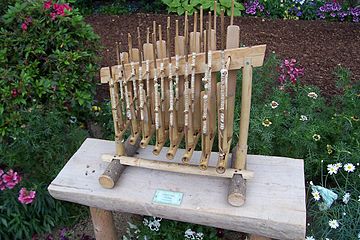
 gongs
gongs kendang
 kenong
 kulintang
 rebab
rebab rebana-jawa
 saron
saron siter
siter so duang
 trompet reog
 blibing
 bonang barung
 saung gauk